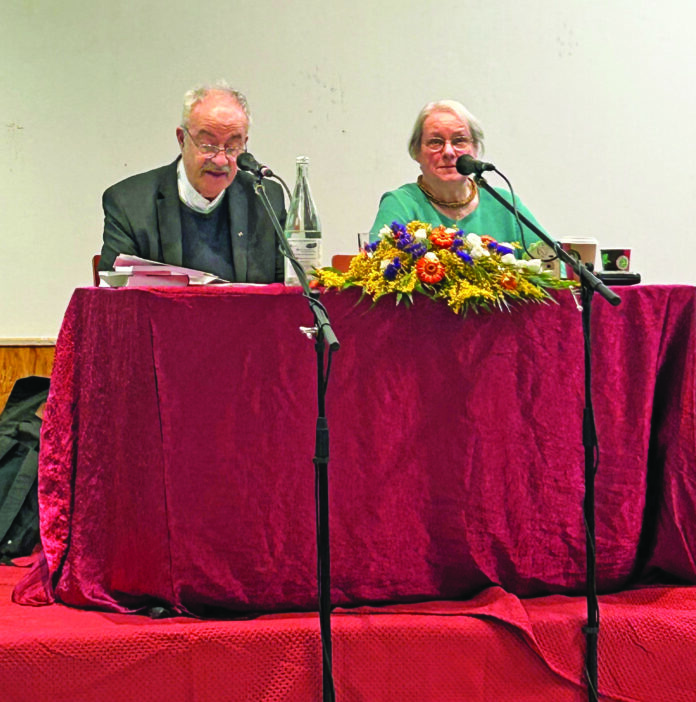
Amill Gorgis and Tessa Hofmann (Stavroula Panagiotidou photo)
Conference in Berlin Looks at Alevite, Pontic and Armenian Genocides
BERLIN, MARCH 26, 2026 — April 24, the day to commemorate the victims of the 1915 Armenian Genocide, is approaching. Sadly, they were not the only victims; among those who escaped physical extinction are countless individuals who were robbed of their identities, their names, their ethnicity, and their religious belief.
That was the “Genocide after the Genocide,” a theme discussed at a daylong conference at the Dersim Cultural Society in Berlin on March 14, and which brought together scholars and representatives of Armenian, Aramaean, and Pontic (Pontian) Greek communities who shared the fate of the two genocides.
Sociologist and genocide scholar Dr. Tessa Hofmann, whose human rights organization AGA (Working Group for Recognition: Against Genocide, for Understanding among Peoples) had launched the initiative, introduced the concept and gave a brief account of the events. The starting point was the genocide of an estimated three million indigenous Christians in the Ottoman Empire between 1912 and 1922, perpetrated by two consecutive regimes: the nationalist Committee of Unity and Progress, known as the Young Turks, and then the Kemalists. The victims were the Christian minorities who included Armenians, the Asyrian/East Syrian Old Church of the Orient, Greek and Syrian Orthodox as well as the Greek and Aramaean Uniate churches.
Citing Raphael Lemkin in his groundbreaking 1944 work, Axis Rule in Occupied Europe, Hofmann identified the survivors as the victims of the “genocide after the genocide,” those whose lives were saved but at the price of total assimilation and self-denial. Genocide “targeted the national group in its entirety and the related actions were aimed at individuals, not as individuals, but as members of a national group.” As she summarized the point, “One might survive, but could no longer be an Armenian, Greek, or Syro-Aramaean Christian.”
What prompted the convening of the daylong Berlin conference was the recent appearance of a Turkish book (2022) in German translation entitled, Alevitische und alevitisierte Armenier: “Wir sind Jesus untertan, wir sind Ali verpflichtet (Alevite and Alevitized Armenians: “We Are the Subjects of Jesus, We Are Committed to Ali”). Author Kazım Gündoğan, of Alevite heritage, is also a filmmaker. Together with his wife, film director Nezahat Gündoǧan, he has researched and produced documentaries on the history of the genocide in the Dersim region.
Among his previous books are The Lost Girls from Dersim, The Monk’s Grandchildren and The Armenians of Dersim, which portray the snuffing out and forced assimilation of the Armenian, Alevite, Kurdish and Zaza peoples in Dersim.
Subjected to political repression and persecution, he left Turkey in 2017 with his wife and child to seek asylum in Germany, where he has continued his work in genocide studies, remembrance, trauma and human rights.
Dersim was the focus of discussion. Out of an estimated population of 200,000 before World War I, Dersim was home to 70,000 Armenians, the rest were Kurdish-speaking Alevites. And during the genocide, up to 40,000 Armenians owed their survival to interventions by their Alevite neighbors, albeit not always selflessly. This changed, Hofmann related, when the Dersim people no longer felt protected by Russia; under the sway of Caucasus front commander Izzet Pasha’s artful diplomatic maneuvering as well as fear for their own safety, they followed government demands to hand over Armenians, who were massacred.
In Dersim, there was also literally a genocide after the genocide, that of the Alevites in 1937-38. Like the first genocide, it began with the elimination of the community’s elite. One motive for the repeated crime was the Kemalist state’s desire to punish Dersim Alevites for having protected Armenians in the earlier genocide. Together they were banished to West Anatolia, whether Islamized, Alevitized, or Christians, many of the latter who under massive pressure converted to Islam.
Gündoğan’s book is a compilation of 72 interviews he and his wife conducted which depict the trauma passed on to the descendants, who, suffering shame and fear of discrimination, tried to conceal their ethnic identity, even from their children; this was often in vain, and neighbors in the know would harass and ostracize the Armenians.
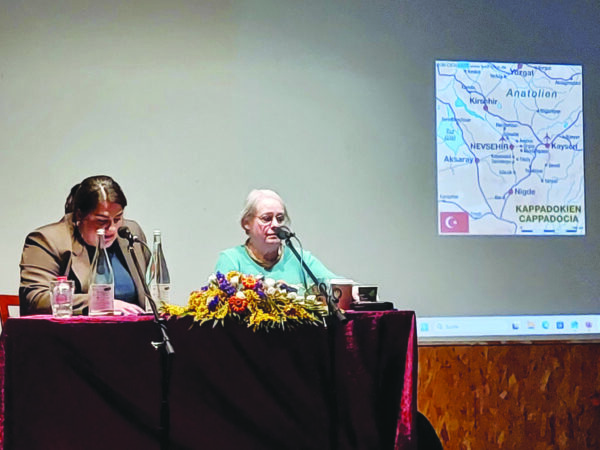
Parthena Iordanidou and Tessa Hofmannn
(Stavroula Panagiotidou photo)
Giving a Voice to the Descendants
Actress Bea Ehlers-Kerbekian brought the drama of the descendants to life, by reading two of the interviews published in Gündoğan’s book. One was with Abbas Tan, a researcher and author, President of the Kayseri Hacı Bektaş Veli Stiftung and Cemevi. He told the story of his grandmother, Varter, who went by the name of Ebe, or Veyve, which meant “bride” in the Dersim Zazaki/Kırmançki language. He once saw the name Varter in his father’s personal document and “I learned from my father that my Ebe was Armenian. At home, we never talked about it.”
Varter “was 17 or 18 in 1915 during the massacres. Her parents were killed, both brothers managed to flee.” Relatives who lived nearby adopted her. “The aunt of my grandfather,” he recalled, “convinced Varter that if she married the aunt’s nephew, she would have the possibility of finding her relatives and no one could harm her.” She knew the names of her parents, nothing more, and never spoke about her family.
“There were dozens of other Armenian women in the region who were in the same situation,“ he said, “but I cannot recall that she had contact with them.“ From an aunt he learned that there had been one girl who visited Ebe now and again, “and spoke Armenian with Ebe secretly, but we don’t know what they talked about.” Once she furtively made the sign of the cross on the blackened bottom of a pan that she had baked bread in. This act angered her husband so that she never did it again. She and other relatives drank wine sometimes with meals, and Ebe remembered that her father had made good wine. When they heard piano music on the radio, Ebe mentioned that she had once played the instrument. These bits and pieces of her past were all that her grandson in his interview could recall.
“She was a person,” he said, “who was angry about her fate. She knew that what she had was no real life, but she accepted it.” Once, under prodding by her grandsons to teach them some Armenian, she refused. “She entered one sentence in cursive handwriting in my notebook, without ever raising the pen from the paper. I kept the notebook for a long time but later lost it…. We never found out what she had written… When she was old, she used to say, ‘I have never laughed, I have never seen the light of day. When I die, bury me in a black shroud and give me no grave, let my place remain anonymous.’” One day in 1982 upon learning that her son had just died, she asked, “Is that so?” and passed away. Abbas Tan said they were both buried on the same day and that her wish had been fulfilled. Even years later, when the graves of the parents were restored, Ebe Varter’s remained nameless. Then it appears that the gravedigger had “Fatiha for her Soul” engraved on the tombstone – a Muslim prayer for the deceased.
Ebe’s story is emblematic of the Armenians robbed of their identities, even after death. Another interview she read, with one Musa Teyhani, depicted the drama of a totally assimilated Armenian family, the grandfather a practicing Alevite. Despite having paid this price for survival, they were discriminated against and physically abused, forced to labor practically like slaves.
A Controversial Theme
In a lively exchange between Hofmann and the author, Gündoğan reported on the reactions his book in Turkish provoked. He characterized the genocide(s) as “a black blemish on the Turkish Republic” which had begun in the 1890s and reached a climax during World War I. After the Treaty of Lausanne in 1923, non-Muslim communities were oppressed locally, forced to convert to Islam. Since the genocide of 1937, oppression has continued to the present. “When I published my book, it was Alevitized Armenians who reacted, because they now saw their experience in a new light.” He was accused of having launched a “slander campaign,” a charge he refuted by stressing that he had published the interviews without any editorial changes. He challenged his detractors to go and talk to the descendants of Armenians who had been forced to become Alevites, their churches destroyed, their belongings and land taken from them. He also took care to distinguish between Alevites who had oppressed Armenians, and others who had protected them.
“I put the documentation together,” he said, “brought it to the public, and I let the readers decide.”
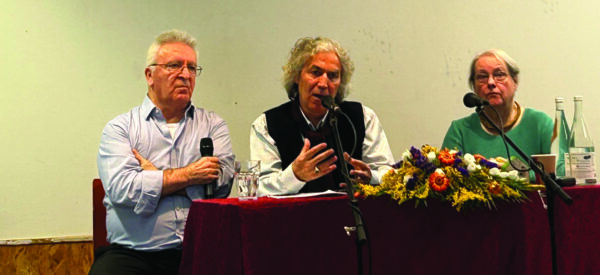
DIDA Translator, Kazim Gündogan, Tessa Hofmann (Stavroula Panagiotidou photo)
Survivors’ Trauma Lives On
Conference participants had a chance to experience the trauma of the survivors’ descendants during the showing of the Gündoǧans’ documentary film, “The Children of Vank.” Reminiscent of the pilgrimages conducted by the late Arman Aroyan of second and third generation Armenians to the villages of their forefathers, the film accompanies descendants to their ancestral villages, where they seek to reestablish a link to their lost Armenian identity. They encounter changed names of towns and villages, rubble, where once there had been churches and homes, deserted landscapes that once were rich farmlands with vegetables and orchards. One old woman recounts how her mother perished trying to cross a river to escape, another says she grew up thinking she and her family were Kurds. Another woman’s mother had told her how the men had been taken away and killed; that is why her mother always wept. Now, the woman said, “I am happy to know that my mother was Armenian.” Others retold stories of their grandparents, about how as children they had hidden under haystacks and survived. Each individual story has a different nuance, but all have something in common.
And the Greek and Syrian-Aramaean survivors? When did the pressure to assimilate or to convert to Islam begin in the regions of Mardin and Pontos? What was the role of tribal societies, their actions or inaction? Not only the Armenians but other Christian communities also suffered. Following the film viewing, Amill Gorgis from the Syrian Orthodox community portrayed the “Syrian-Aramaean Experience” and, in discussion with Hofmann, the similarities and differences with the destiny of other Christian minorities came to the fore.
A presentation on “The Experience of Pontic-Greek Survivors in the Pontos Region” was cancelled due to the illness of planned speaker Tamer Çilingir, a Pontic Greek Muslim. In the Pontos region as well as in Dersim, Greeks were forced to convert to Islam, as Armenians were forced to become Alevites. The new “hybrid” identity thereby produced Çilingir has dubbed the “Black Sea identity,” more regional than religious; the identity of Armenians from Dersim ranges from a hybrid identity (Christian-Alevite), Alevite, and Atheist.
In conclusion, Parthena Iordanidou, a leading representative of the Pontic Greek societies in Germany and Europe, read the report from a Greek survivor, the member of a family in Cappadocia forced to convert to Islam.