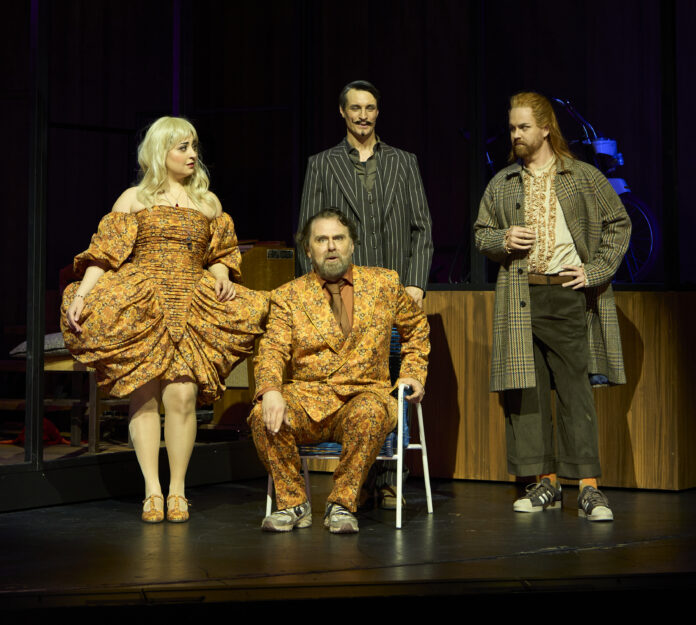
Sofronia, Dr. Malatesta, Ernesto_ seated Don Pasquale.
Photo Nils Heck
Ofeliya Poghosyan Delights Opera Fans in Darmstadt
by Muriel Mirak-Weissbach
DARMSTADT, Germany APRIL 23, 2026 — “Thou shouldst not have been old till thou hadst been wise,” says the Fool to the ageing monarch in Shakespeare’s King Lear. The king has done the unthinkable: divided his kingdom, imperiling national unity and opening the way to civil strife and war. As often in times of crisis, it seems caprice, not reason, rules policy and stability is threatened by the arrogance and miscalculation of the grandiose self. In such historical moments, great art can exert an uplifting power, either through the catharsis of tragedy, or the relief of comedy. Parody, in its elevated form of comic opera, works to expose the follies of human behavior and invites careful self-reflection. Catharsis here comes in the form of laughter.
Gaetano Donizetti was a master of “opera buffa” — comic opera — and his “Don Pasquale,” which premiered at the Darmstadt State Theater on March 27, is a stunning example — even though the composer himself called it a “dramma buffo” and for good reason. Guest artists joined the Darmstadt ensemble and chorus in a cast that featured bass baritone Oliver Zwarg, baritone David Pichlmaier, tenor Theordore Browne, soprano Ofeliya Poghosyan, and bass baritone Pedro Ometto. It was a superb performance under director Geertje Boeden, dramatization by Frederike Prick-Hoffmann, chorus direction of Guillaume Fauch?re and musical direction of Johannes Zahn.
Starring as Norina (“Sofronia”) was Armenian soprano Poghosyan, who joined the ensemble last year. The accomplished young artist began her musical education at the St. Petersburg State Conservatory under the guidance of Irina Bogacheva and Dmitry Karpov. Before coming to Darmstadt, she performed at the renowned Semperoper Dresden from 2021 to 2023, where she completed the Young Artists Program, and as a guest performer in 2023/2024. She was an ensemble member at the Hagen Theater in 2024/2025. In summer 2025, following her debut as Clorinda in Rossini’s “La Cenerentola” in Darmstadt, she was engaged as a soloist in the ensemble for the 2025/2027 season.
Poghosyan has performed leading roles in several operas, including Gran Sacerdotessa in “Aida,” First Nymph in “Rusalka,” La Voce dal Cielo in “Don Carlo,” Papagena in “Die Zauberflöte,” Lisa in “La Sonnambula,” Musetta in “La Bohème” and the Fifth Maid in “Elektra.” Her rendition of Norina, the leading lady and only female soloist in “Don Pasquale,” was outstanding. Both as singer and actor she brought the challenging role — or roles — to life; endowed with a rich, full soprano voice, her delivery was controlled and secure while at the same time astonishingly free. She seems to sing the most intricate passages and embellishments effortlessly and to enjoy every moment on stage.
Love, Marriage, … and Money
The plot has standard opera buffa elements: a love story, disguise, intrigue and happy ending. Ernesto, a romantic young man, is in love with Norina, a young widow of slender means, not averse to remarrying. Ernesto’s wealthy but stingy uncle, aristocrat Don Pasquale, demands he marry a wealthy woman, or risk losing his inheritance. When Ernesto refuses, the ageing bachelor, played by internationally renowned bass baritone Oliver Zwarg, decides to take a wife himself and start a family. He seeks help from his friend Doctor Malatesta to find an appropriate bride. Malatesta, portrayed by baritone David Pichlmaier, hatches a plot: he will present as just the right candidate his alleged “sister” Sofronia, currently living in a convent, and recruits the intelligent and beautiful Norina to disguise herself as the fiancée. Don Pasquale should fall for the modest and charming Sofronia, marry her in a (fake) ceremony presided over by Malatesta’s cousin — a would-be “notary” played by bass baritone Pedro Ometto — and with a marriage contract ceding half his fortune to his bride as well as total control over the household.
Ernesto, portrayed by lyrical tenor Theodore Browne, is utterly unaware of the plot and believes his friend Malatesta has betrayed him by finding a mate for his uncle. Desperately fearing he has lost Norina, he writes her a farewell letter, saying he is leaving the house and the country. Malatesta brings his would-be sister Sofronia to Don Pasquale, who, bowled over by her demure, chaste demeanor, agrees to the marriage, contract and all. No sooner has the ink dried than Sofronia unveils her true character as an imperious female, seizes command of the household, hires more servants, and organizes expensive home renovations, exasperating her baffled husband. Don Pasquale “discovers” a letter penned by his wife to a secret lover, which gives rise to Malatesta’s next ploy: to lie in wait in the garden and surprise the lovers in flagrante. By now recruited into the plot, Ernesto plays his role but flees in time. As Don Pasquale and Malatesta approach, Sofronia sheds her disguise, revealing her true identity as Norina, Ernesto’s beloved. Don Pasquale accepts defeat and even consents to the young pair’s marriage.
Virtuosity in Voice and Characterization
Poghosyan displays her versatility from the onset, expressing genuine sorrow and dismay when she receives Ernesto’s letter, then childlike excitement when Malatesta explains his plot and her role in it. “Pronta son, purch’io non manchi – Ready I am, provided that I don’t fail,” she sings with devilish delight. When Malatesta accompanies her disguised as Sofronia to Don Pasquale’s home, she enters with bashful hesitation, fully veiled and dressed in white, cowering in feigned piety. Immediately after the mock ceremony, she flings off her bridal veils to reveal a “fashionable” dress, blond curls, and a rash temper. The costumes designed by Anna Brandstätter are wonderful parodies; Sofronia’s chaste white bridal attire is as ornate as a Viennese frosted cake and her second outfit is a strapless dress with puff sleeves and puffy, bloomer-like mini skirt—all matching Don Pasquale’s suit.
Don Pasquale is helpless as Sofronia exerts dictatorial power over the household and her would-be husband. When he raises objections to her being chaperoned by Ernesto for an evening stroll, she spares the elderly gent no ridicule, singing, as if to a naughty child, “Via, caro sposino – Please, my dear little hubby…” Audiences may sympathize with Don Pasquale as the victim of a quasi-criminal intrigue, but none of the characters – least of all, Norina/Sofronia – show any concern.
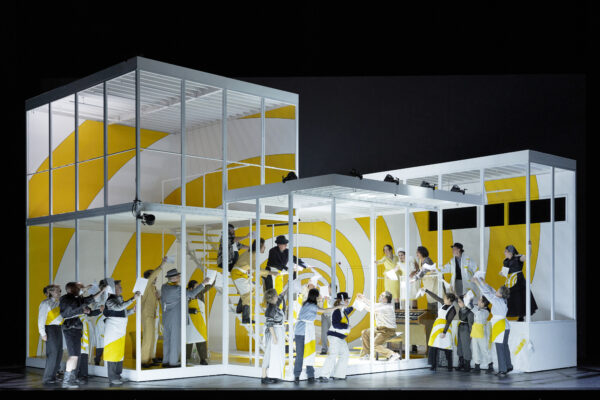
Don Pasquale with expanded staff Photo Nils Heck
The Moral of the Story
The finale of Malatesta’s scheme, in which the lovers are discovered, unfolds in an enchanted garden lush with gigantic yellow and purple crocuses 10 to 13 feet tall, and populated by oversized snails and other elegant creatures who gracefully dance, prance, or rhythmically inch across the stage — a sumptuously florid scene reminiscent of Alice in Wonderland — in which the quasi-tragic adventure of a foolish old man finds resolution in harmony with the natural world. The final quartet spells it out: “The moral in all this is quite easy to find.” To wit: He who takes a wife in advanced age is quite foolish.Rather than have Don Pasquale stomp off the stage in an angry huff, Donizetti allows him to attain a certain moral stature, for he consents to the marriage of Ernesto and Norina. As the Darmstädter Echo newspaper commented, Oliver Zwarg, “endowed with an agile and finely nuanced baritone voice, plays the title role not as a feebleminded old man, but as one with dignity and a trace of sensitivity.”
The final set represents the culmination of a series of daring designs by Robert Schweer. It stands in sharp contrast to earlier sets, which ranged from the chintzy interior of Pasquale’s 1970s-style “suburban baroque” decorated in yellows/brown/orange-patterned fabrics (like his clothes) to the interiors renovated and redecorated by Sofronia, interiors constructed with a combination of empty frames defining spatial relations of rooms, with mobile upper and lower levels accessed at times by stairs. The garden is the paradise gained after escaping the cage-like structure of the old man’s residence.
The premiere was a resounding success. The capacity audience responded with loud enthusiasm and standing ovation, roaring with praise for leading lady Poghosyan. Some of the secrets to her success were revealed in a podcast/discussion with Oliver Zwarg. When she began singing at the age of 8, she had very supportive parents who helped accommodate her school duties with music rehearsals, which she believes contributed to her feeling at ease and relaxed on stage. As for her remarkable command of bel canto, which Zwang rightly noted is a challenging technique requiring discipline, she said for her it was rather “a dream.” She also highlighted the congenial atmosphere among the cast: “I have very good colleagues,” she quipped. “It is important to have fun on stage!”
Don Pasquale will be performed five more times this season. That said, Poghosyan’s next premiere took place on April 18, when she appeared as Poppea in “The Coronation of Poppea” (in German) by Claudio Monteverdi. Other roles this season include Donna Elvira in “Don Giovanni” and Clorinda in “La Cenerentola.”