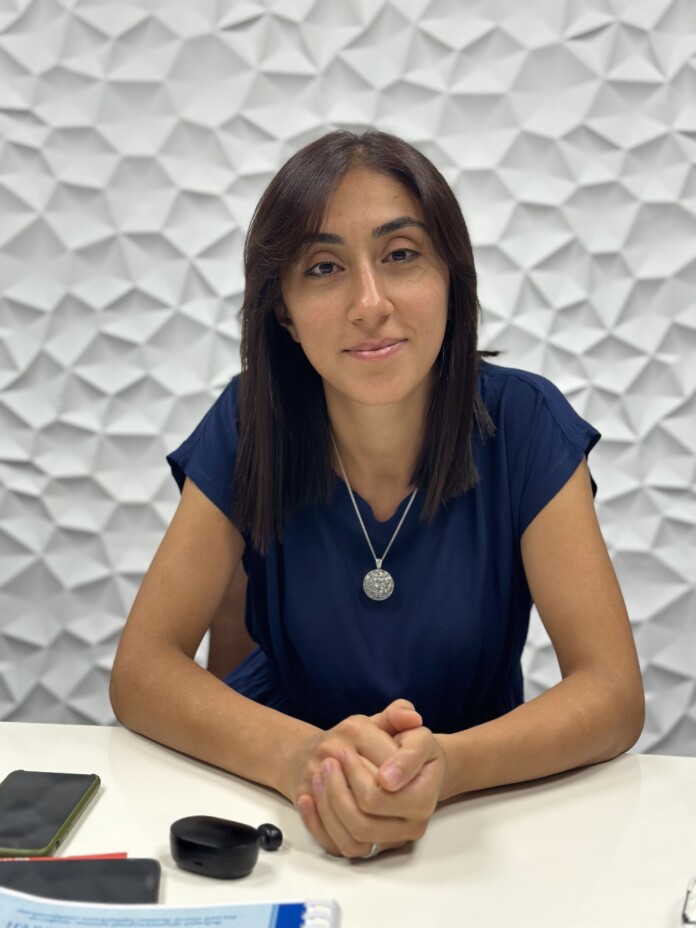
Arpi Khalatyan
Advancing Therapy and Psychological Education in Armenia
by Muriel Mirak-Weissbach
JUNE 25, 2026 – Since 2020, the Armenian people have undergone a series of crises on multiple fronts, crises that have created challenging needs for intervention. Armenian soldiers returning from the 2020 war, followed by tens of thousands Ukrainian refugees and Russian emigres on the heels of the 2022 Russian invasion, and the expulsion of 100,000 Armenians from Artsakh in 2023, have created successive waves of demographic, economic and psychological pressures on the entire population.
If returning soldiers, refugees, and emigres have been traumatized, the general population and organizations tasked with accommodating the inflow of newcomers have been overwhelmed. Anxiety, fear, insecurity — all symptoms of overall stress — have come to dominate personal life.
Government as well as private and volunteer agencies have been meeting the needs for material support, including housing, employment and education, but what facilities and personnel are available to deal with subjective needs — psychological and social support? What is the status of psychotherapy in Armenia? A report submitted to the Mirror-Spectator by Arpi Khalatyan, a psychologist leading a new professional organization committed to improving the quality and availability of psychotherapy in Armenia, identified the leading problems and innovative efforts to solve them. The following summarizes her report.
It may come as a surprise to learn that psychologists in Armenia are not licensed, the entire sector is unregulated. This means that anyone can declare professional competence as a psychologist, set up practice and start treating people in need. Without governmental or institutional regulation, no one bears responsibility for the quality of care provided, or the consequences a client may experience.
This reflects shortcomings in educational opportunities for psychologists.
Yerevan State University, Yerevan State Pedagogical University and the National Academy of Sciences are the three main providers of education in the field, plus a few small private universities that offer programs or psychology departments. University programs do provide basic education in the field, but with very little practical education or internship. Thus, highly-motivated graduates headed for a career as therapists will seek experience in small psychological centers, participate at their own expense in internships or various types of practical training, short- and medium-term educational and practice-based programs. Many students go to work in schools and kindergartens or other child-centered institutions as child psychologists and begin their psychological careers there. Others seek work as psychologists in hospitals. There is, however, also a group of graduates who immediately begin seeing clients without further preparation or guidance. The one positive aspect is that there are numerous psychological centers in Armenia founded by individual professional psychologists, which have more than ten years of experience in both practice and education, and which have trained multiple generations of psychologists following the model described above.
A Jungian Approach
In 2021, a group of 8 analytical psychologists founded the Armenian Association of Analytical Psychology (AAAP) to meet the need for a specialized professional community. In coordination with the C. G. Jung Institute in Zurich, the AAAP became a member of the International Association of Analytical Psychology (IAAP), providing interaction conducive to further individual development. Co-founder and current president of the AAAP is Arpi Khalatyan, who received her BA and MA in psychology from Yerevan State University, followed by specialized education in Training for Trainers Programs at the YSU Center of Applies Psychology, and Jungian Analysis. Jungian Analysis is based on the work of Swiss psychiatrist and psychologist Carl Gustav Jung (1875-1961), who has influenced psychotherapy, literature, religious studies, anthropology, education and the arts throughout the world.
Like Khalatyan, since the 2020 war many AAAP members have actively participated as volunteer psychologists in hospitals, providing psychological support and counseling to returning soldiers. She herself worked in a program aimed at organizing reskilling and upskilling courses or even career transition programs for war participants, doing needs assessments and guiding conversations with them, advocating and helping to solve problems with documents. Several members have also worked with displaced people from Artsakh and with individuals affected by forced displacement.
One major problem that therapists face in individuals traumatized by war is recurrent nightmares. dreams about wars, murder, brutal torture and mutilation. Here, the methodology of analytical psychology becomes extremely important, based as it is on working with symbols. Practitioners of this approach aid clients in understanding their dreams, interpreting symbols and thus gaining insight into the processes occurring in their psyche, the sources of their anxiety and other factors that reduce their quality of life. It also helps them find the healing sources within themselves.
In its focus on training programs, the AAAP has organized 19 webinars on different topics.
In response to the lack of official accreditation in Armenia, the AAAP is working to establish proper licensing standards. All individuals who participate in the international association’s program through the national AAAP organization undergo a training process that may last 6–8 years, during which they take three examinations and, after the final exam, receive an international certificate of qualification in analytical psychology. This serves both as a marker of credibility and as a way of demonstrating to the state and government how essential professional licensing in psychology is.
In this regard, as Khalatyan stresses, membership in the international Jungian community is particularly important for the AAAP. It allows Armenian professionals to participate in global discussions, receive training from internationally recognized analysts and contribute perspectives shaped by Armenia’s unique cultural and historical experience. In August 2025, Khalatyan led a delegation to Zurich to attend the 23rd International Congress of Analytical Psychology, which brought together more than 1,800 participants and among them some of the most influential voices in the field. For the Armenian representatives, the congress offered an opportunity to attend panels and lectures on pressing contemporary issues — ranging from trauma and cultural identity to the future of training in analytical psychology — as well as a chance to introduce the AAAP to leading scholars. The reception was encouraging; many, in fact, expressed their willingness to collaborate with Armenia. In June of this year, Swiss Professor Verena Kast, an internationally renowned Jungian analyst, educator and author, visited Armenia and conducted a four-day intensive workshop covering a range of topics within analytical psychology.
Despite Jung’s influence worldwide, in Armenia, access to his writings remains limited. While his ideas are widely discussed, none of his major works is available in Armenian translation. To address this gap, the AAAP has launched an ambitious long-term project to translate some of his key works into Armenian.